Free Shipping Across India
You could’ve done everything right. Matched OE numbers, cross-referenced with the VIN (Vehicle Identification Number), and made sure of fitment.
But the part you received can still be wrong for your car as a pre-order checklist isn't the same as a spare parts quality checklist.
When buying aftermarket parts, you may encounter brands that are unfamiliar to you. An unfamiliar brand is not automatically counterfeit, but you should verify the supplier, packaging, part number, warranty terms and product documentation before installation.
TL;DR
-
Pre-order checklist confirms fitment but doesn’t assure you of the parts quality. And counterfeit parts can cause serious issues like part failures and frequent wear.
-
Genuine vs fake car parts packaging can be easily spotted. Reputed brands’ packaging include a clear logo of the brand, part number and other details printed on it.
-
Cross check part number across all three factors - packaging, part and the listing. If found mismatched, contact the seller.
-
Compare the new part with the older part for dimension, mounting points, and connectors. In case that isn’t possible, double-check with the dimensions mentioned in the listing.
-
Check the part’s finishing, plating, welds and plastic finish. Rubber and seal components should be checked for suppleness.
Why a Quality Check Still Matters After You've Ordered the Right Part

Around 20% of accidents in India happen due to counterfeit products according to a 2018 report of FICCI Cascade. Knowing how to check car spare part quality before installation is important because it saves from issues such as:
-
Failed Insurance/Warranty Claims: If a part is counterfeit, incorrectly installed or not approved under the applicable policy or warranty terms, the resulting damage may create complications during a claim or warranty assessment. Check the relevant terms before installation and retain the invoice and product documentation.
-
Premature Replacements: A low-quality or incorrectly specified part may wear out sooner or fail prematurely, increasing total ownership cost. Compare the supplier’s reputation, specifications, warranty and price rather than judging quality only by brand familiarity.
-
Compounding Damage: A failed or incorrectly specified part can place additional stress on related components. For example, a defective oil filter may restrict flow, leak, fail to seal or trigger the filter’s bypass system, potentially contributing to lubrication problems. Always match the filter to the exact engine and application.
A damaged, counterfeit or poorly manufactured part can create safety and reliability risks. Before installation, use the packaging, markings, physical condition, fitment details and supplier documentation as part of a broader inspection.
Packaging: What Should Packaging Look Like
Packaging is one of the first areas to inspect, but it is not conclusive evidence of quality or authenticity. Established brands may use labelled packaging with product and traceability information, but legitimate parts can also arrive in plain, bulk or workshop packaging. Do not treat plain packaging alone as proof that a part is fake.
A car part packaging checklist also includes the brand's name and, in some cases, QR codes or holograms for verification. Look for a part number or barcode printed on the box that matches both the part itself and what was ordered.
If the listing says that fitting hardware, gaskets, seals or brackets are included, confirm that they are present. A warranty card may provide useful information, but its presence does not prove that the product is genuine or that the warranty will be accepted.
Part Numbers: A Quick Cross-Check
A part number is one of the quickest ways to check a part’s intended application, but it is not a standalone quality or authenticity check.

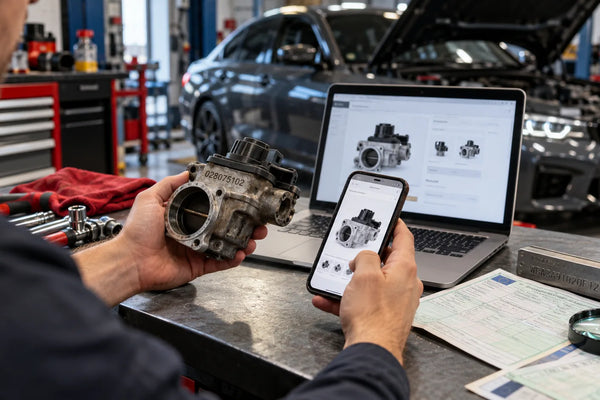
A part number check for car parts includes matching the number printed on the box, the number stamped or printed on the part itself, and the number shown in the listing. And if they don’t match, treat it as a reason to contact the seller before installing.
To make sure a part fits through OE part numbers and how to read them by brand, read AtoZ Auto Part's OE part number matching guide.
Fitment: Assessing Critical Points Before Installation
Once you receive the part, carry out a physical inspection before attempting installation. These checks can identify obvious fitment problems, but they do not replace VIN or catalogue verification.
During a car part fitment check before installation, compare the new part with the old one side by side, checking mounting points, connector shape and pin count, orientation, dimensions and component markings. A superseded part may look different while remaining compatible, so verify any difference through the catalogue or seller.
Compare weight only as a secondary clue. A lighter part is not automatically inferior because manufacturers may use different materials or designs. A significant unexplained difference should prompt a catalogue, supplier or manufacturer check rather than an immediate conclusion.
If the old part is unavailable, compare the new part with the dimensions, specifications, photographs and application details provided in the listing.

Finish: What to Check in the Physical Part
The part’s surface finish and material condition can reveal visible manufacturing or storage problems, but they do not establish overall quality on their own.
Here’s everything you need to look for in a car part finish quality check:
-
Where applicable, check for even paint or plating, with no obvious drips, patchiness, peeling or exposed bare metal at edges and mounting areas.
-
Clean weld seams on metal brackets and assemblies, without excessive spatter or an uneven bead.
-
Plastic components should be free from excessive mould flash, sharp burrs, cracks, distortion or damage around mounting points. Odour alone is not a reliable indicator of quality or authenticity.
-
Rubber seals, bushings and hoses should not show cracks, surface splitting, excessive stickiness or unexpected brittleness. Hardness varies by material, so compare the part with the specification or original component where possible.
-
Check threads, bolts and mounting studs for damage, contamination and cross-threading. Do not force a fastener if it does not engage smoothly.
What to Do If Something Fails the Check
Once you know how to spot counterfeit car parts, you can easily spot discrepancies in the part. In case you find any, contact the seller with the specific mismatch or defect.
Record each observable issue, such as mismatched mounting points, damaged packaging, inconsistent markings, missing hardware, cracks, burrs or uneven finishing. Send the seller clear photographs and a written description.
Review the return policy before opening, modifying or installing the part. Check whether installation, removed labels, damaged packaging or missing hardware affects return or replacement eligibility.

To check the common returns and delivery specifications of Indian auto parts stores, read AtoZ Auto Part's delivery-and-returns guide.
Your Spare Parts Quality Checklist at a Glance
Checking the quality of a part before installation can save you a lot of trouble. Here’s a complete spare parts quality checklist:
The Packaging: Check the packaging for product and traceability information. QR codes or holograms may provide an additional verification step, but scan them only through a trusted device and confirm that the destination is the manufacturer’s official website or verification channel.
The Part Itself: Check whether a part number is marked on the part and whether it matches the listing. Then inspect paint, plating, welds and plastic finish for consistency and defects. Also, compare mounting points and connectors with the older part.
The Decision: If you find a visible defect, missing component or unexplained mismatch, photograph it before installation and contact the seller. Request a return, replacement or clarification according to the applicable policy.

Conclusion
Checking the VIN and part reference before ordering helps verify fitment. But it does not guarantee the part’s quality, condition or authenticity.
You need to know how to check car spare part quality once you have the part in your hand and before it is installed.
Start with the packaging and check the brand, part reference, traceability information, seals and condition. Then inspect the part’s markings, finish, mounting points, connectors and visible material defects. Compare it side by side with the old part where available, while remembering that revised parts may look different.
At AtoZ Auto Parts, we offer aftermarket components across selected luxury vehicles like BMW, Mercedes-Benz and more. Browse the catalogue or contact our team with your VIN, existing-part reference and vehicle details to review fitment before ordering.
Frequently Asked Questions
1. Does unbranded packaging always mean a fake part?
Not always, but it is an important step in the spare parts quality checklist. Treat it as a reason to check part number, fitment, and finish more carefully.
2. Is a lighter part always a lower-quality part?
Not automatically. Some genuine parts do use lighter materials by design. But it's worth comparing against the original part's weight for car spare parts inspection india.
3. What if the part number matches but the finish looks poor?
Do not move forward with the installation and report the part. A matching part number confirms it's the right part, not that it's well made.
4. Should quality check happen before or after installing?
Before. If you know how to spot counterfeit car parts before installation, it's far easier to resolve the issue by contacting the seller than after the part has been fitted.